Photographer's Year-End Marketing Calendar: Oct–Dec
Stories AR team

The last quarter is when a photographer's year is made or lost. Mini-sessions, holiday cards, calendars and gift certificates all compete for the same weeks, and the difference between a chaotic December and a profitable one is usually a calendar written in October. Here is a practical month-by-month plan — with a note at each stage on where living-photo products slot in as a premium add-on rather than a separate hustle.
Quick answer
Plan backwards from print deadlines: book holiday mini-sessions in October, shoot and sell through November, and shift to gift certificates once print labs close in mid-December. At each stage, AR products — cards, calendars and framed prints that play video when scanned — work as premium add-ons that raise the average check without adding shooting time.
Key takeaways
- Work backwards from the print lab's December cutoff — it, not the holiday itself, is your real deadline.
- October is for booking and packaging, November for shooting and selling, December for delivery and gift certificates.
- AR add-ons reuse material you already shot: behind-the-scenes video becomes the living layer of a printed product.
- Gift certificates rescue late December, when there is no time left to shoot or print.
- The PRO plan's 20 AR photos per month covers a full mini-session season at $24/month billed yearly.
October: packages, pricing, booking
October's job is to sell November. Announce holiday mini-sessions now — short 20–30 minute slots, one decorated scene, a fixed set of deliverables. Clients book earlier every year, and the photographers who publish dates in mid-October fill their calendars before the competition wakes up.
This is also the month to design your product menu. Decide what a base package includes and what counts as an add-on: extra retouched frames, printed cards, a desk calendar — and the AR tier: a living photo version of the client's favorite shot, where the printed picture plays a video when scanned. Creating one takes minutes, so the add-on costs you almost nothing to fulfill.
Run the numbers before you set prices. The photographer earnings calculator shows what AR add-ons do to a season's revenue at your volume — it is easier to price confidently when you have seen the math.
November: shoot weeks and the sales window
November splits in two. The first half is shooting: batch mini-sessions on weekends, keep the scene identical, keep slots tight. During each session, capture 20–30 seconds of video alongside the stills — kids laughing, the family walking into frame, confetti. That footage is free to shoot in the moment and impossible to recreate later; it becomes the video layer of every AR product you sell afterwards.
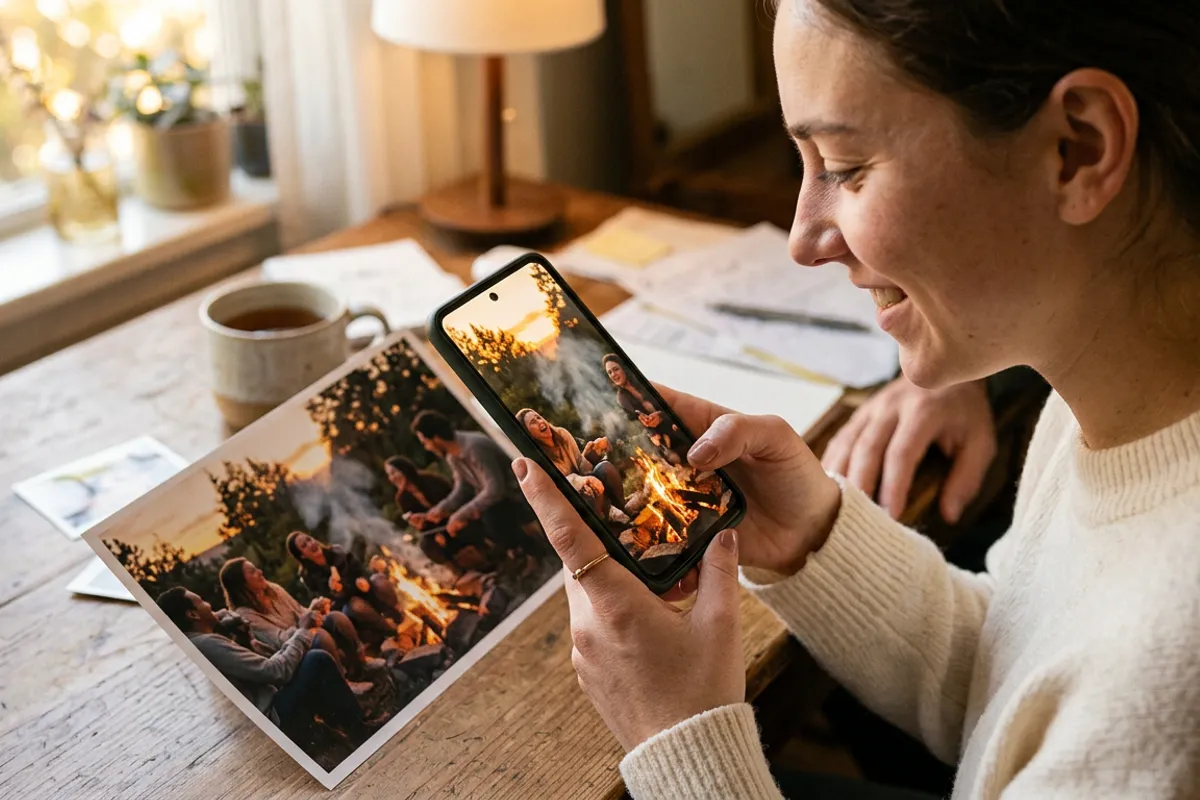
The second half is selling. Deliver galleries fast and present print products while the session is still warm: holiday cards from the shoot, a wall calendar with twelve picks, framed prints. At the reveal, demonstrate one living photo on your own phone — a print coming alive is a product clients did not know existed, and seeing it converts better than describing it.
Logistics note: every printed product ordered in November has to reach the lab by early December. Put the lab's actual cutoff dates in your calendar now and quote delivery honestly.

December: delivery, certificates, and the quiet upsell
Early December is fulfillment: final print orders out, AR pairs created and QR codes placed on cards, calendars and frames. Test-scan every product before handover — a matte print of a detailed photo tracks best; flat backgrounds and glossy varnish can fail.
From mid-December, printing is over but selling is not. Gift certificates take over: a certificate for a winter or spring shoot is the classic last-minute gift and requires zero production. A certificate can itself be a small AR object — a printed card that plays a short video of you explaining what the recipient will get.
One more December habit: swap videos. Products with QR codes can be updated without reprinting, so a card delivered before Christmas can play a new clip for New Year.
Where AR fits at each stage — the one-table view
The pattern across the quarter is the same: AR is never a separate product line, it is the premium version of something you already sell.
- Mini-session package → tier with one living photo included; higher tiers include more.
- Holiday cards → same card, plus a QR code that plays the family's video greeting.
- Wall calendar → cover or each month's photo plays a clip from the year.
- Framed print → the gift version that moves when grandparents scan it.
- Gift certificate → a printed card that plays your 20-second pitch to the recipient.
What the AR side costs you
The PRO plan is $24/month billed yearly and includes 20 AR photos per month — one busy mini-session weekend's worth of add-ons. More than 62 000 photographers already work this way, and the mechanics are deliberately fast: upload photo plus video, get a QR code, place it in the layout.
Because the QR code never changes, fulfillment risk is low: if a client wants a different clip after delivery, you replace the video in the dashboard and the printed product updates itself.
Add an AR tier to your holiday menu
First AR photos are free — build one demo living photo now and show it at every November reveal.
Start for freeFrequently asked questions
When should I announce holiday mini-sessions?+
Mid-October at the latest. Clients book earlier every year, and print deadlines mean sessions must happen in November anyway.
Do AR add-ons require extra shooting time?+
Almost none. Capture 20–30 seconds of video during the regular session — that footage becomes the living layer of any printed product.
What if the client wants changes after the product is printed?+
The video can be replaced anytime in the dashboard without reprinting — the QR code on the product stays the same.
What sells after the print labs close in December?+
Gift certificates for winter and spring shoots. They need no production and fit the last-minute gift window perfectly.